How the assistant fits your phone
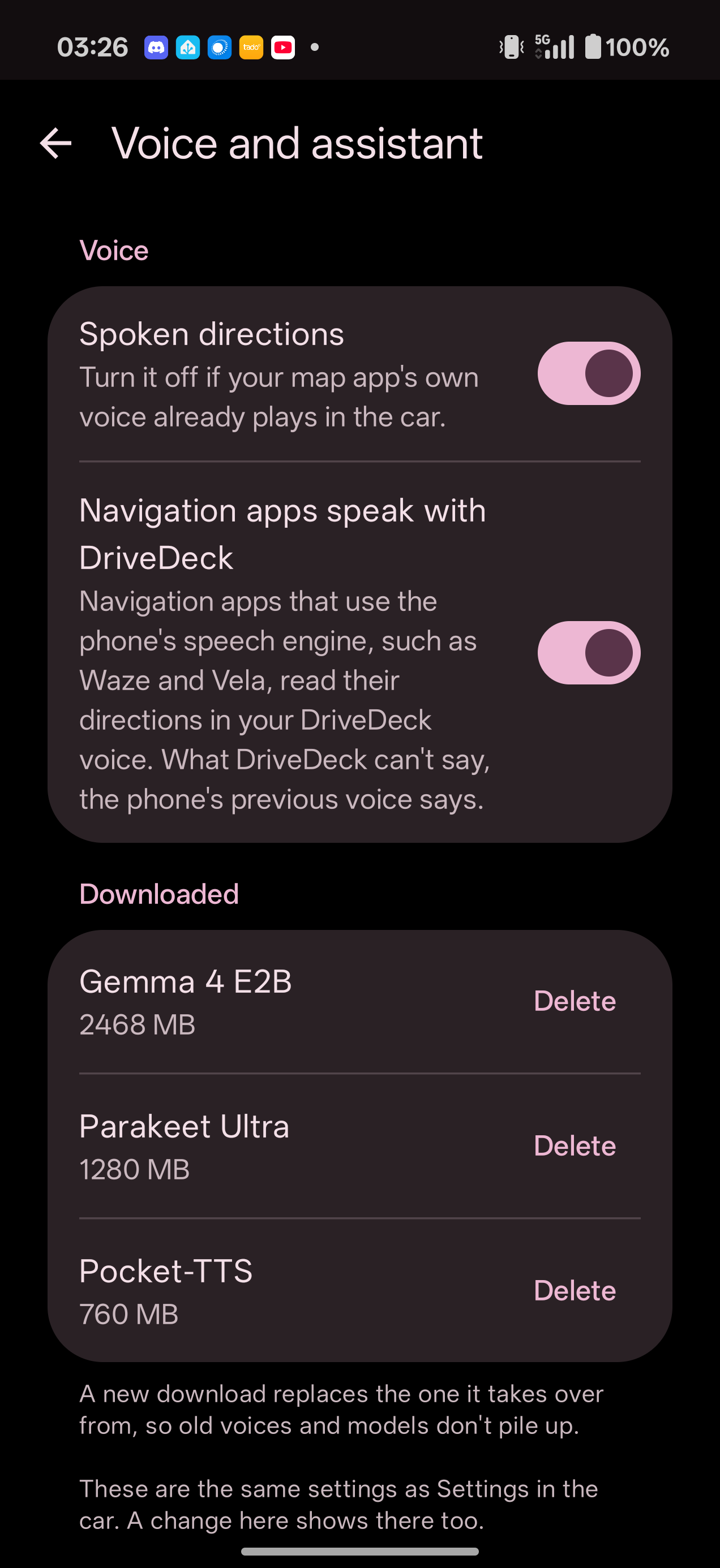
The installed phone model packages shown in Voice and assistant.
TL;DR: DriveDeck runs a 2.4 GB instruction-tuned model (Gemma 4 E2B, LiteRT-LM) entirely on the driver's phone. We used to gate it on "does the model load on the phone's GPU", which could reject phones with capable CPUs and unsupported GPUs. Main now classifies phones by CPU feature flags and performance-core count, and can try an eligible GPU before falling back to the CPU.
This post assumes you know what on-device LLM inference involves (prefill, decode, quantization). Numbers are Android-side; model details are on the Gemma 4 E2B card.
The workload is prefill, not decode
DriveDeck's assistant is a tool router: the model reads a ~610-token system prompt (tools, car state, the driver's words) and either calls a tool or answers briefly. Decode speed barely matters — measured labels were identical across backends — so time to first token (TTFT) on the production prompt is the verdict metric: ≤2 s "works well", ≤4 s "works", beyond that "unsuitable".
Measured reference, OnePlus 15 (Snapdragon 8 Elite Gen 5, 16 GB, Android 17):
| Backend | 610-token TTFT | Notes |
|---|---|---|
| CPU, 8 threads | 0.77–1.04 s | ~600–808 tok/s prefill |
| CPU, 6 threads | 0.89–1.16 s | the shipped default on all-big-core phones |
| GPU (Adreno 840) | 1.09–1.12 s, 7.0 s load | warm requests after loading |
On the same phone, a 3.01-second synthesized English clip took 80–93 ms on 4–8 CPU threads. This is a short desk measurement, not a sustained or in-car result.
Why the GPU gate was wrong
The GPU is the fragile part of the stack. Xclipse GPUs have shown failures or invalid output under LiteRT-LM; device and runtime behavior can vary. PowerVR (Tensor) needs workarounds and a token cap. Even Adreno can be blocked
by vendor UI. Meanwhile the CPU got fast: LiteRT's XNNPACK picks up Arm KleidiAI SME
kernels at runtime, so an all-big-core sme phone beats most GPU paths anyway.
The old rule — a GPU the model loads on — therefore rejected exactly the phones whose CPUs are fine, and on our own reference phone the CPU is the faster backend.
What main does now
- Before the download: check arm64, Android 13+, and physical RAM (≥6 GB; "virtual
RAM" never counts). Then classify the CPU from its feature flags and performance-core
count (all cores except in-order A55/A510/A520):
sme/sme2works well,i8mmwith ≥6 performance cores works,i8mmwith 4–5 may be slow, older A78/A76-class cores are off. The settings say exactly which check failed. - Backend choice: The CPU uses up to six performance cores. The GPU can be attempted first where it is eligible — Adreno and Mali, PowerVR opt-in, never Xclipse — and a failed GPU load can fall back to the CPU in the same load. Both backends can still fail.
- Graceful degradation: a load that fails on GPU and CPU isn't retried for two minutes; commands in between go straight to the built-in offline commands. Three total failures in a row (never a success) within one app version mark the assistant unavailable with a Try again button. A phone that ever loaded the model keeps it.
- Diagnostics: the settings can copy a plain-text profile — chip, CPU flags and performance cores, RAM, GPU, Android version and page size, runtime/model versions, the assigned class, last backend and result. No personal data.
The full chip-by-chip matrix (every 2026 flagship class, mid-range splits on i8mm,
unsuitable tiers), the calibration design and the research sources live in
the suitability report.
Trade-offs and limits
- Most per-chip TTFT figures are estimates scaled from four measured anchors (our OnePlus 15, Google's S26 Ultra card, an Arm SME2 phone, a Raspberry Pi 5). Classification is a suitability estimate, not proof of performance on a particular phone; per-chip numbers in the report carry ranges.
- GPU stays interesting. Google's warm-GPU numbers (0.3 s TTFT, 676 MB RSS vs 1,733 MB on CPU) beat the CPU on Adreno flagships — after a 7 s load and with the per-vendor fragility described above. The backend probe is kept off the gating path so a GPU hiccup never blocks an answer.
- NPU is out of scope for now: QNN compile took 130–146 s per load with no cache in our test; MediaTek's NPU numbers are strong but need vendor-compiled models.
- SME support depends on the build: XNNPACK turns SME off for Clang < 18, and there was a SIGILL-class cpuinfo bug fixed upstream on 2026-11-10 — which is exactly why the classification treats unknown CPUs as unknown, not as suitable.
Measurement and reproduction
These are short debug-build desk runs on one phone, using a roughly 610-token prompt and 1–2-token labels. They are not sustained or in-car measurements. The measurement record records the build, model revisions, runner and raw-log paths.
DriveDeck is AGPL-3.0; the classifier lives in
gearslip/src/main/java/app/seb3thehacker/gearslip/assistant/AssistantSettings.kt on
GitLab or Codeberg. The evaluation harness is
AssistantEvalTest; the measurement scripts and notes are under docs/research/.